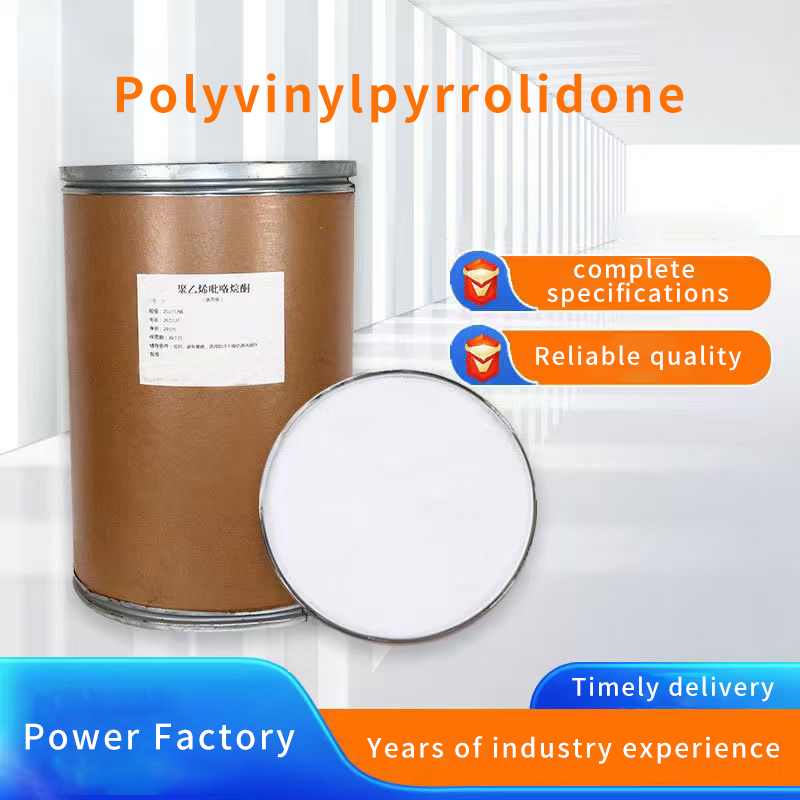
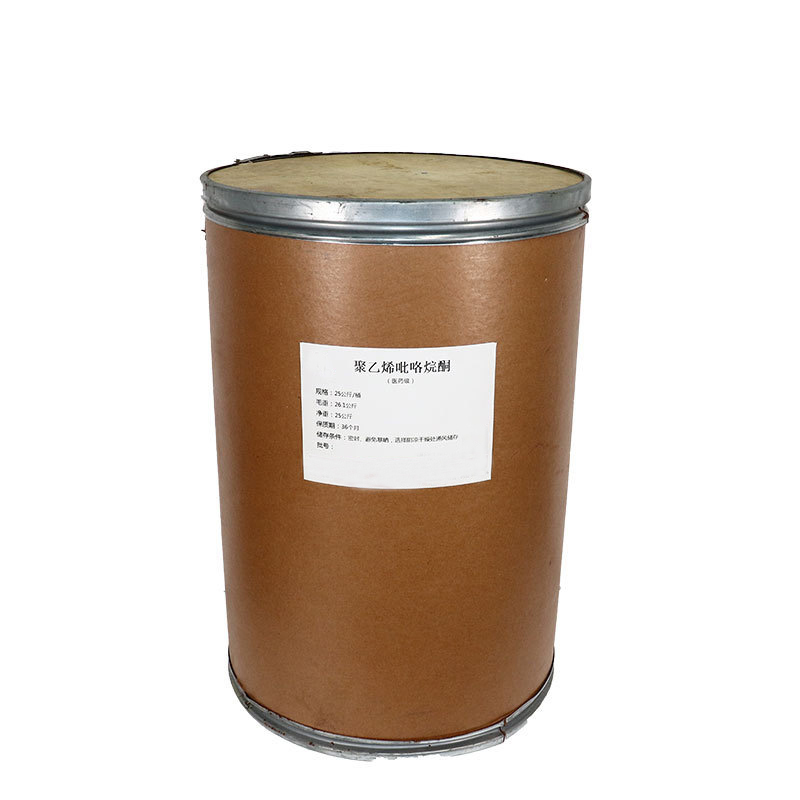
Polyvinylpyrrolidone Pvp K30 K90 99% USP Bp CAS 9003-39-8
Polyvinylpyrrolidone (PVP), CAS number 9003-39-8, is a non-ionic polymer with extensive industrial and pharmaceutical applications. The following provides a detailed overview from four aspects: chemical properties, physical properties, application areas, and safety information:
Chemical Properties
1. Molecular Formula and Structure
– Molecular Formula: (C6H9NO)n, polymerized from N-vinylpyrrolidone monomers
– Contains an internal amide ring, conferring excellent chelating ability and biocompatibility.
2. Solubility:
– Soluble in water, forming a transparent colloidal solution, with solubility increasing with temperature.
– Soluble in polar organic solvents such as ethanol and chloroform, but insoluble in non-polar solvents such as acetone and diethyl ether.
– Compatible with most inorganic salts and resins, such as forming complexes with iodine (e.g., polyvinylpyrrolidone iodine, which has antibacterial properties).
3. Chemical stability:
– Resistant to light and heat, but may decompose in the presence of strong oxidizing agents (e.g., ammonium persulfate).
– Under light or oxidizing agent exposure, the solution may gelify; heating with strong bases may produce precipitates.
4. Complexing ability:
– Can form complexes with phenols, alkaloids, etc., and is commonly used for drug purification or impurity removal.
– For example: precipitating polyphenolic substances in plant extracts to improve the accuracy of protein measurements.
Physical Properties
1. Appearance and Form:
– White or off-white powder or granules, odorless or slightly odorous, with hygroscopic properties.
– The form of products with different molecular weights may vary slightly (e.g., high-molecular-weight PVP may appear as a waxy solid).
2. Density and Melting Point:
– Density: Approximately 1.144 g/cm³ (25°C), with some sources indicating a range of 1.23–1.29 g/cm³.
– Melting point: Approximately 130°C (some sources indicate >300°C, which may be related to molecular weight or testing conditions).
– Boiling point: 217.6°C (760 mmHg).
Technical data sheet
Polyvinylpyrrolidone Applications
1. Cosmetics Industry:
* Hair styling agents: Form elastic films in hair gels and mousses, imparting shine and combability to hair.
* Skin care moisturizers: Serve as emollient bases, improving product viscosity and stability.
* Hair dye dispersants: Uniformly disperse dyes and prevent precipitation.
2. Food and Beverage Industry:
* Beer Stabilizer: Acts as a polyphenol adsorbent to improve clarity and color.
* Juice Clarifier: Removes suspended particles to enhance product stability.
3. Industrial Applications:
* Textile Dyeing: Acts as a fiber treatment agent to improve dyeing uniformity.
*Paper industry: Acts as a paper processing aid to enhance paper strength.
*Adhesives: Acts as a thickener to improve bonding performance.
*Electroplating: Acts as a brightener to improve coating quality.
4. Biochemical Research:
*Western Blot blocking agent: Reduces non-specific binding to improve experimental accuracy.
*Nucleic acid hybridization: Acts as a molecular biology reagent to assist experimental operations.